











Terre Hill had to fight to become its own town. Back when it was still called Fairville, the village on the hill was part of East Earl Township, and in 1907 it won a court battle to break away and incorporate as a borough. More than a century later it is still one of the smallest boroughs in Lancaster County, with the clock on the borough hall, a summer of Terre Hill Days in the park, and a view down over the Weaverland Valley.
That view is the reason a lot of people here are surprised when their basement takes water. You live on top of the hill. Rain should run away from you, down into the valley. And eventually it does. The trouble is the part in between, when the water has come off your roof and your yard and has not left yet. In Terre Hill that is exactly when it finds the foundation.
Why Water Stalls on a Terre Hill Lot
The high ground in this corner of the county is heavy soil over red shale. Clay like this does not soak up a summer thunderstorm. The first half inch of rain fills it up, and everything after that runs across the surface or just below it, following the grade. On a hilltop lot the grade usually falls away from the house in one direction and toward it from another, so part of your foundation is downhill from your own yard.
Then the water reaches the backfill. The soil right against a basement wall was dug out and pushed back in when the house was built, and it never packs as tight as the undisturbed clay around it. It works like a gutter around the house. Water runs into that loose ring of soil, sits on the clay, and leans on the block until it finds the cove joint where the wall meets the floor.
The result is a pattern we hear about all the time in hilltop towns: the yard looks fine an hour after a storm, but there is a wet stripe along one basement wall that night, and it is still damp two days later.
Start With the Roof, Because It Is the Biggest Source
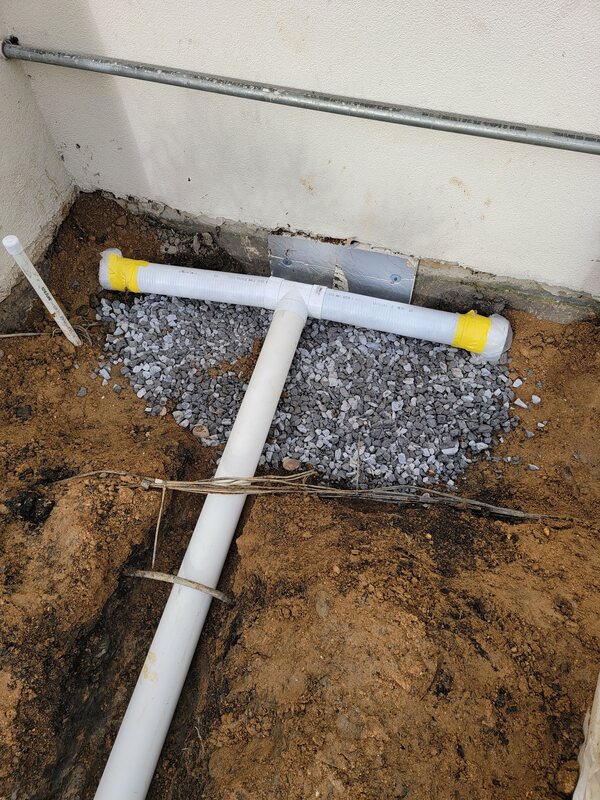
Before anyone talks about drains in the yard, look at the downspouts. An inch of rain on 1,000 square feet of roof is about 620 gallons of water, and most houses have more roof than that. All of it comes down four or five downspouts. If those downspouts empty onto a splash block next to the wall, you are pouring hundreds of gallons into that loose backfill every time it storms.
The fix is to get roof water well away from the house before it touches the ground. Above-ground extensions are a cheap start, but they get kicked aside and run over by the mower. The better answer is to bury the downspout lines: smooth-wall solid pipe, not perforated, sloped all the way to an outlet that is downhill and well clear of the foundation. Perforated pipe has no business carrying roof water, because it leaks that water back into the soil right where you were trying to get rid of it.
Grading matters too. Building code asks for the ground to fall at least six inches in the first ten feet away from the foundation. On older lots, settled backfill and years of mulch often leave it flat or tilted back toward the house. Regrading that strip is not glamorous work, but it decides where a lot of the water goes.
Catch the Water Coming Down the Hill
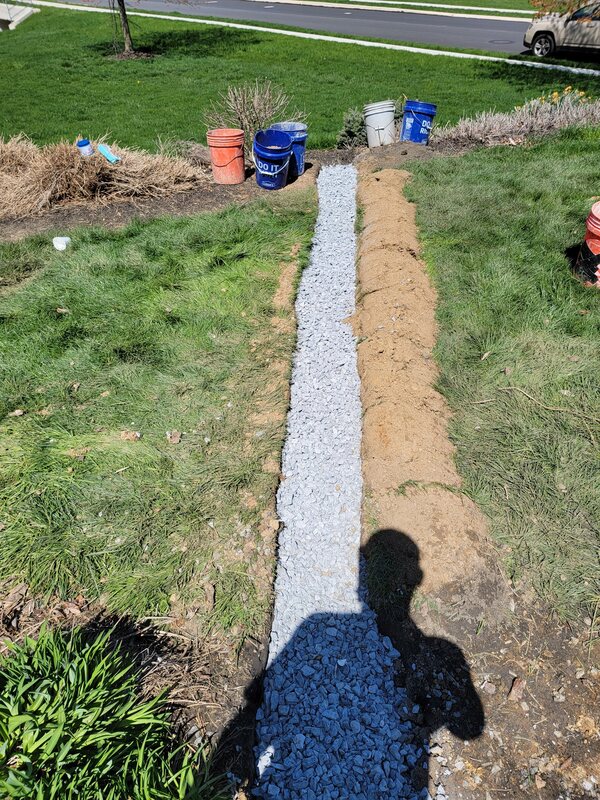
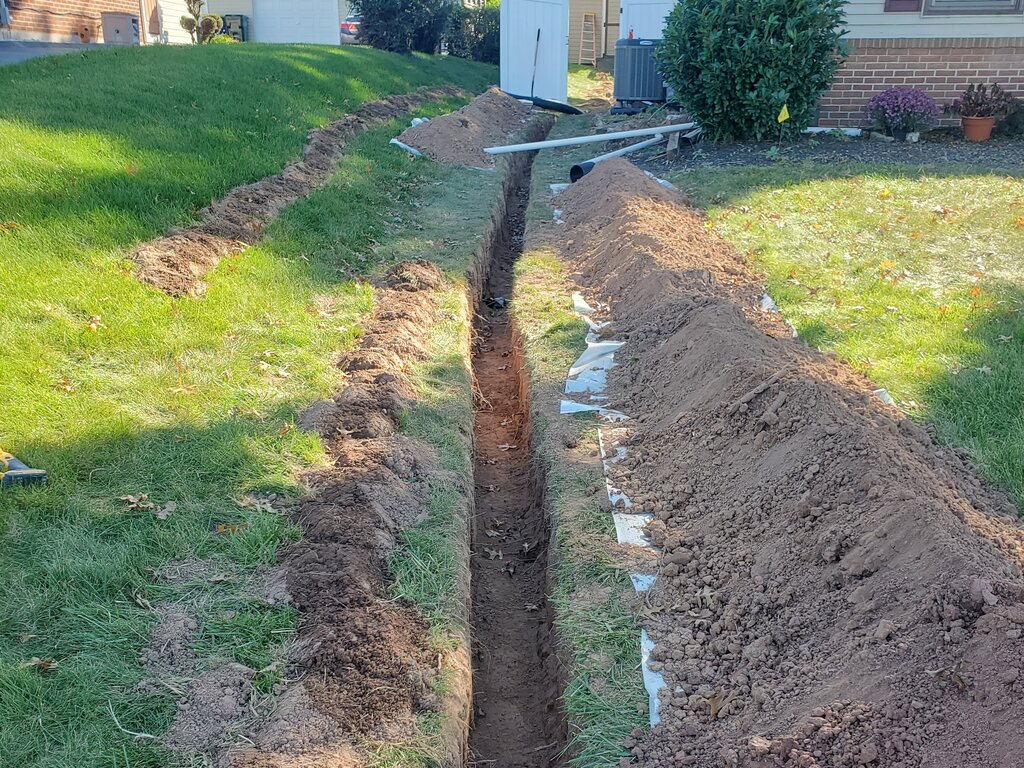
Roof water is the part you can see. The other part comes across the lawn from uphill, through the topsoil and along the top of the clay. For that, the tool is a yard drain on the uphill side of the house, sometimes called a curtain drain. It is the same idea we wrote about in our story on the farmer behind the French drain: a trench across the slope, lined with filter fabric, a perforated pipe in clean stone, and enough fall to carry what it collects somewhere harmless.
Placement is everything. Too close to the house and it sits in the disturbed backfill. Too shallow and the water slides underneath it on top of the clay. We dig to where the water is actually moving, and we set the run so it intercepts the water across the whole uphill side, not just at the one corner where the puddle shows up.
Where the Water Goes: Daylight or a Dry Well
Collecting water is only half the job. It still needs somewhere to go, and this is where living on a hill works in your favor. On most Terre Hill lots the ground keeps falling past the edge of the yard, so the best outlet is simply daylight: the pipe runs downhill until it can come out of the ground at a lower spot on your own property, where the water spreads out on the grass instead of against a wall.
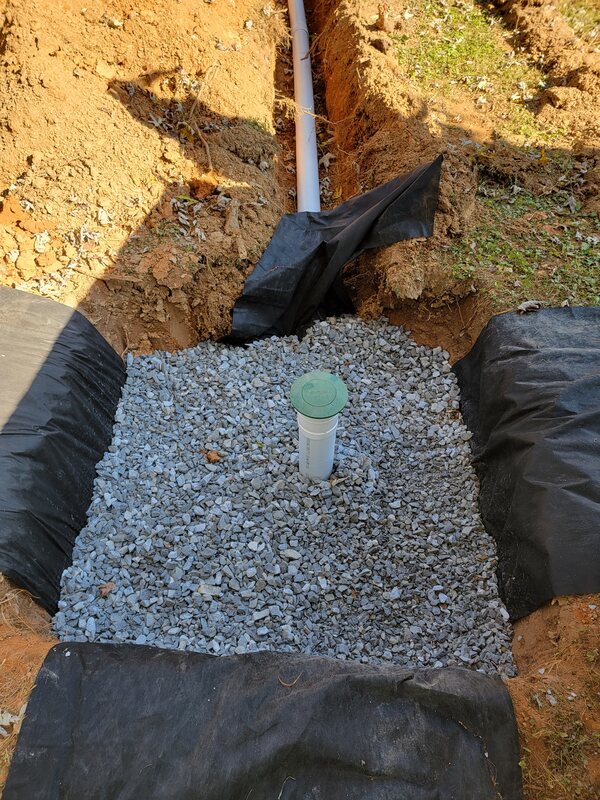
When the lot is too flat or too tight for that, the other option is a dry well. That is a pit lined with filter fabric and filled with clean stone, sometimes with a plastic chamber inside, that holds a storm's worth of water and lets it soak away slowly. In heavy clay a dry well has to be sized generously and needs an overflow, because the soil around it drains slowly. A small dry well in Terre Hill clay just fills up and backs water into the pipe. We check how the soil takes water before we recommend one.
One more rule: the outlet has to stay on your property and cannot be aimed at a neighbor's yard or foundation. On a hill, your downhill neighbor is the first person to notice if it is.
When the Yard Is Not the Whole Problem
Good drainage outside takes the pressure off a basement, and for a lot of homes with a damp wall or a corner that seeps after big storms, it is the whole fix. But if water is coming up through the floor, or the basement still takes water after the downspouts and grading are sorted out, the water is coming from deeper in the ground than a yard drain can reach.
That is when an interior perimeter drain and sump make sense, and we will tell you plainly which situation you are in. Our page on drainage solutions covers the outdoor work, our page on basement waterproofing in Terre Hill covers the inside, and the basement waterproofing cost guide shows what each one usually runs. You can also read more about the ground conditions on our Terre Hill page.
Send the Water Down Into the Valley Where It Belongs
Terre Hill earned its place on the hill, and your house can stay dry up there too. The water just needs a planned route off the lot instead of the one it finds on its own. If you have soggy ground by the foundation, downspouts that dump next to the wall, or a basement wall that gets wet after every big storm, call Basement Gurus at (800) 834-6584. We will walk the yard with you, show you where the water is going and why, and give you a written estimate for sending it somewhere else.
Frequently asked questions
Do I need a yard drain or just longer downspouts in Terre Hill?
Start with the downspouts. On many hilltop lots, burying the downspout lines and fixing the grading next to the house solves most of the problem. If water still crosses the yard from uphill and collects at the foundation after that, a yard drain on the uphill side is the next step. We look at both before recommending anything.
Does a dry well work in heavy clay soil?
It can, but it has to be bigger than a dry well in sandy soil and it needs an overflow, because clay lets water soak away slowly. When the lot slopes enough, sending the pipe out to daylight at a lower spot on the property is usually more reliable than a dry well in clay.
Can I run my drainage pipe toward my neighbor's property?
No. Collected water should come out on your own property and should not be directed at a neighbor's yard or house. We plan the outlet so it stays on your lot and spreads out on open ground away from any building.