











For more than a century, the Slumbering Groundhog Lodge in Quarryville has gathered every February to see whether Octoraro Orphie spots his shadow. It is one of the oldest groundhog traditions in Pennsylvania, and people around southern Lancaster County take it about as seriously as a groundhog deserves.
A groundhog knows something about this end of the county that most homeowners learn the hard way. The soil here is thin. Dig a few feet down almost anywhere around Quarryville and you hit rock. A groundhog builds his burrow on the high side of a slope so it stays dry, because he knows the water in that thin soil runs downhill along the top of the rock. Your house sits in the same ground, and if it sits on a slope, one of your basement walls is in that water's path.
Why Water Finds the Uphill Wall in Quarryville
In much of southern Lancaster County there are only a few feet of soil over Piedmont schist and quartzite. When it rains, the water soaks in, reaches the rock, and cannot go any deeper. So it turns and travels downhill along the top of the bedrock, underground and out of sight, until something gets in its way.
On a sloped Quarryville lot, that something is the foundation. The water piles up against the uphill wall, pushes through the joints in the block, and seeps out where the wall meets the floor. The downhill side of the house often stays completely dry. That is why so many homeowners in Quarryville and Eden Township describe the same problem: one wall, the same wall, every time.
The timing is the other giveaway. Water that fell up the hill is still working its way down to you for days after the storm ends. If your basement keeps seeping on the second or third sunny day, the water is coming through the ground, and fixing the gutters alone will not stop it.
Signs Your Quarryville Basement Has a Hillside Water Problem
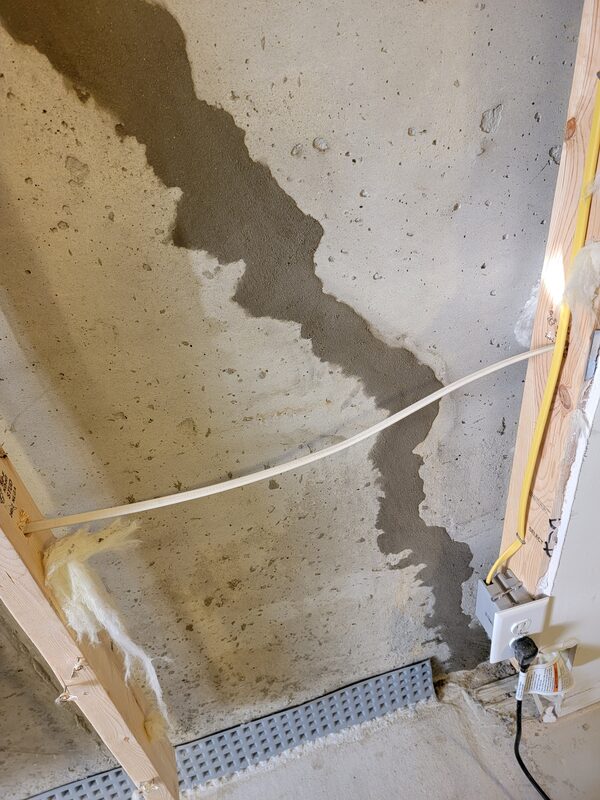
Hillside water leaves a pattern. Look for a dark, damp band along the bottom of one wall, white chalky efflorescence on the block, or a wet stain that spreads out from a crack the way the one in this photo does. Peel back a corner of carpet on the uphill side and you may find the pad is damp while the rest of the room is fine.
Outside, the clues are often in the yard. A soggy patch on the slope above the house that never quite dries, moss along the foundation on the high side, or a downspout that empties toward the hill all point to water heading your way.
Fall is a good time to deal with it. Once the ground starts freezing and thawing, and the snow on the hill above you starts to melt around the time Orphie makes his forecast, that uphill wall will be taking on more water than it did all summer.
How Basement Gurus Waterproofs a Quarryville Basement
The most reliable fix is to catch the water where it arrives and give it an easy way out. Inside the basement, we cut out a strip of the floor along the affected walls and dig a trench down beside the footing. That is the point where the water from the hill reaches your foundation, so that is where the drain belongs.
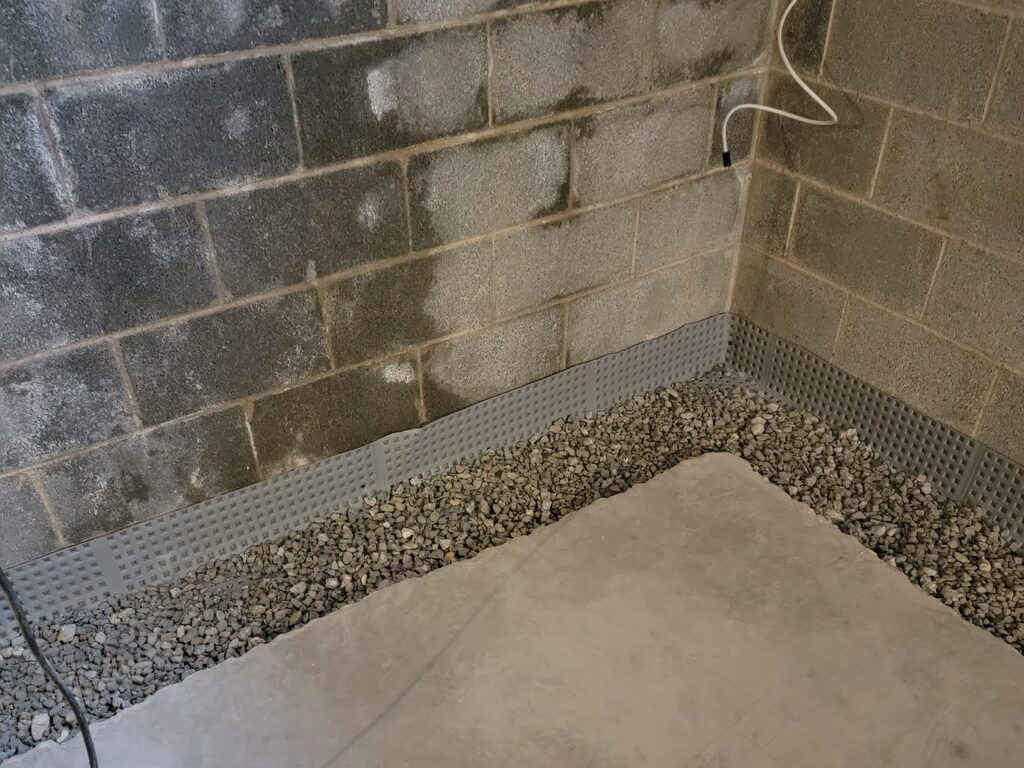
The trench gets a perforated drain pipe bedded in clean, washed stone, which you can see in the photo at the top of this page. A dimpled membrane goes against the base of the wall. Any water that pushes through the block or the cove joint runs down behind the membrane, into the stone, and into the pipe instead of across your floor. The drain carries that water to a sump basin, and a pump sends it out of the house. Then we pour new concrete over the trench, and the system disappears under the floor.
Where the discharge goes matters just as much on a hillside lot. If the pipe empties on the uphill side, or too close to the house, the same water simply walks back down to your wall. We route it far enough downslope to stay gone. On properties where the grade gives us room, we may also add an exterior drain on the high side to intercept water before it ever reaches the foundation.
You can see the full range of options on our basement waterproofing page, and our page on basement waterproofing in Quarryville goes deeper into how we size systems for the shallow bedrock in Eden Township.
Why Sealers and Paint Rarely Hold
A lot of Quarryville basements we visit have a coat or two of waterproofing paint on the uphill wall. It looks fine for a season. Then the water behind the wall keeps pushing, the paint blisters and flakes, and the white efflorescence comes right back through.
Coatings can help with light dampness on a wall that is otherwise dry. On a slope with water riding the bedrock, the pressure behind the block is too steady for paint to win. Draining that water away at the footing takes the pressure off the wall, which is what keeps the basement dry year after year.
Get Ahead of the Water Before Groundhog Day
Whatever Orphie predicts in February, the hill above your house will send water toward your basement every spring. If one wall of your basement keeps getting wet, or you are planning to finish the space and want to be sure it stays dry, call Basement Gurus at (800) 834-6584. We will walk the property, show you which way the water is moving, and give you a written estimate for what it takes to keep it out.
Frequently asked questions
Can I just waterproof the one wall that leaks in my Quarryville basement?
Often, yes. On a hillside lot the water usually arrives at the uphill wall, so the interior drain can be focused there and along the adjoining corners. We check every wall before quoting, because sometimes a second wall is starting to show the same signs and it is cheaper to include it now.
How long does an interior drain system take to install?
Most interior waterproofing jobs take one to three days, depending on how many feet of wall need the drain and whether a new sump basin goes in. The floor is patched with fresh concrete when the drain is in, and you can use the basement again right away.
Will interior waterproofing let me finish my basement?
It is usually the first step. A perimeter drain and wall membrane keep groundwater away from the new walls and flooring, so moisture does not end up trapped behind drywall. If you plan to finish the space later, tell our estimator so we can lay out the system with that in mind.